
Megan Brown
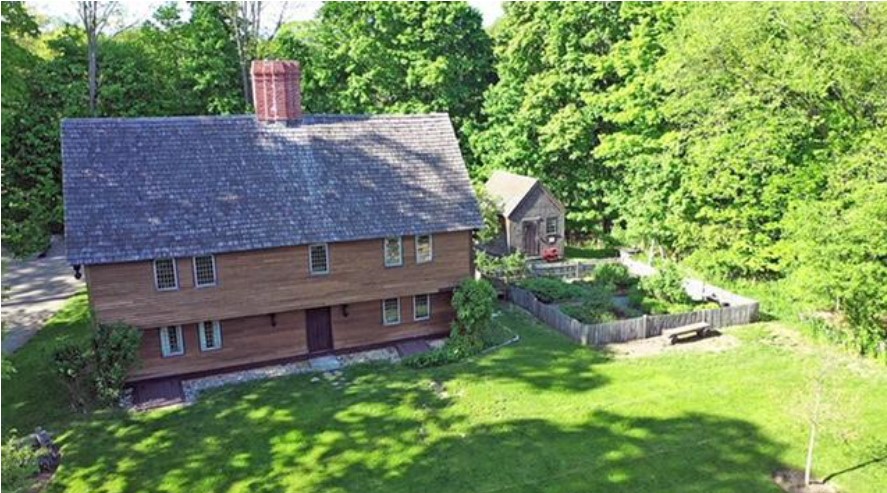
The Parson Capen House is one of the finest surviving examples of Elizabethan architecture in America. The house is situated on a knoll overlooking the Common, originally on a twelve-acre lot of land granted Reverend Capen by the Town in 1682. Parson Capen served the Church in Topsfield for 44 years until his death.
Parson Joseph Capen was the minister in Topsfield during the witch trials of 1692. His house, described by The Architectural Record in 1915 as, “One of the best-preserved houses of the earlier colonial period in New England,” still stands today at 1 Howlett Street. It has been owned and maintained by the Topsfield Historical Society since 1913.
The Topsfield Historical Society purchased the house in 1913. It was restored under the direction of George Francis Dow, and an official housewarming was held on January 14, 1914.
Joseph Capen, born in Dorchester, MA in 1658, and graduated from Harvard College in 1677, agreed to become Topsfield’s minister in 1682, but declined to live in the existing parsonage which had been the home of ministers Thomas Gilbert and Jeremiah Hobart. He was given twelve acres “of land and meadow and swamp,” where he built his house in 1683 (the date of ‘July 8, 1683’ is inscribed on a beam in the parlor).
Capen was ordained as Topsfield’s minister in 1684. That same year, he married Priscilla Appleton of Ipswich, with whom he had seven children. At the time he became Topsfield’s minister, the Topsfield
congregation included Isaac and Mary Easty, and John and Sarah Wildes. The wives of both couples were hanged for witchcraft eight years later. The congregation included many people who were involved in the
tragedy – among them members of the Hobbs family, the How family, Nehemiah Abbott, the Gould family and the Redington family – both accused and accusers.
Capen, who led his congregation for forty years until his death in 1725, appears to have been a calm and reasonable voice during the dramatic and tragic events. He was a contributor to Cotton Mather’s Return of Several Ministers written in June of 1692, written after Governor Phipps consulted the congregational ministers for their input on their legal view of witchcraft under the new charter. The contributing ministers cautioned against the use of spectral evidence and folk tests as proof of guilt.
Parson Capen was one of the ministers who signed the introduction to Increase Mather’s Cases of Conscience of Evil Spirits, which reiterated that the devil could take on the appearance of an innocent person. Spectral evidence would no longer be allowed in future court cases.
Joseph Capen died on July 30, 1725, at the age of 66. His wife Priscilla died on October 18, 1743, at the age of 85. They are buried in the Pine Grove Cemetery. Their graves are said to mark the location of the pulpit of the second meetinghouse (1663-1703).
Anna Balch Jordan, the great-great-great granddaughter of Joseph and Priscilla Capen, inherited the house from her father in 1897. In 1913, she sold it to the Topsfield Historical Society, whose secretary George Francis Dow then beautifully restored the building. Dow’s invaluable History of Topsfield, Massachusetts was published in 1940.
The Parson Capen House was designated a National Historic Landmark in 1960.
Text from Salem Witch museum and Topsfield Historical Society
PRISCILLA CAPEN HERB SOCIETY
By Joyce Bergsten
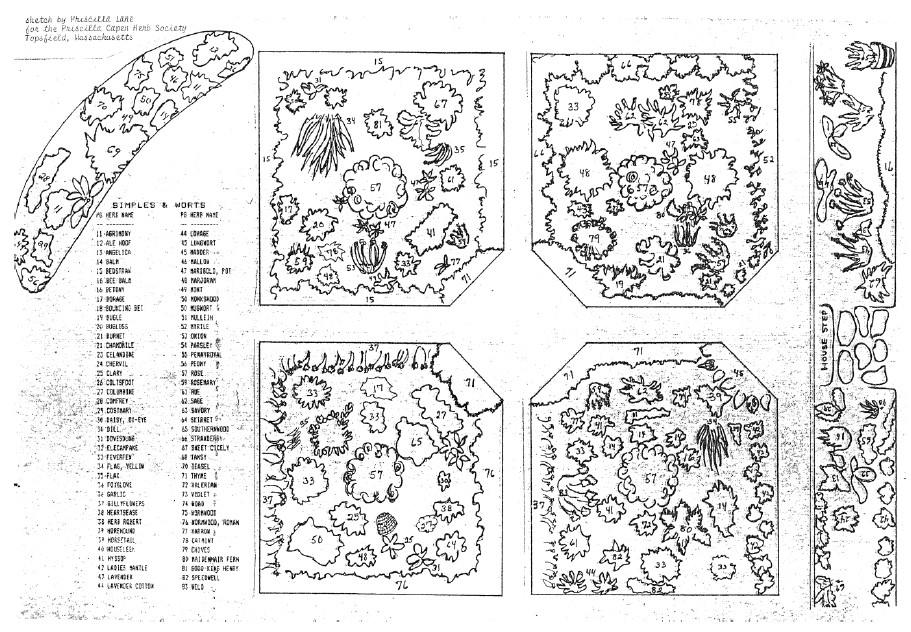
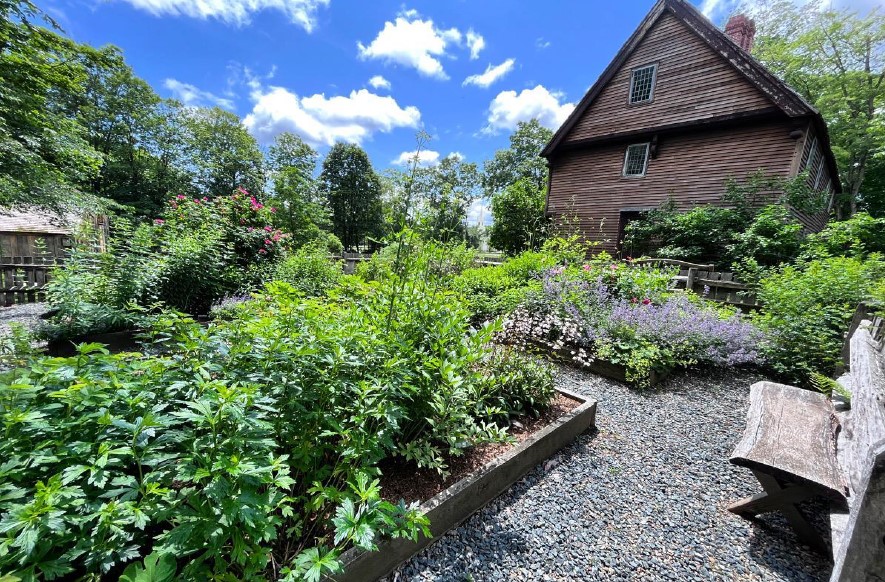
In the spring of 1978, a group of women from the Topsfield Historical Society decided to raise a “kitchen garden” next to the famous Capen House. Elaine Dow was the chairman assisted by Anne Peirce, Bunny Nutter, and Mrs. H. W. Smith, an authority on colonial gardens, as a consultant.
The four-bed raised gardens required 2 workdays in May. Every plant would have been well known to Priscilla Capen. Some herbs were used for medicines, cooking dyes, repelling rodents, and freshening rooms, cloth, or “laying out the dead”. Mrs. David Brown served a sit-down dinner. Ten women were dressed in colonial clothing. Food was served in pewter chargers and Redstone tankards for ale or cider. On future workdays men dug postholes and erected a split rail fence around the gardens.
The Priscilla Capen Herb women began to serve tea at the gardens in the summer of 1979. On August 15th Lillian Kemper and Joyce Bergsten served 20 guests with cold borage tea (that instills courage in those who drink it) and herbal goodies. Candlelight suppers were started in October at the Capen house for the members. By the summer of 1981, thirty women were helping to maintain the authentic 17th
century gardens. Teas were held every Wednesday from 2 to 4 in the summer. The women created herbal crafts and charts to be sold at the Thanksgiving Boutique. A new cutting garden was created at
the back of the house under the direction of Ruth Ratto, Joyce Bergsten, Kathy MacGregor, Ruth Moore and Kathy Chadwick.
In 1982 Elaine Dow wrote a book called Simples and worts using herbs from the garden for her
illustrations by David Workman. In 1983 the Parson Capen House celebrated its 300th birthday. Elaine and Bob Dow were the chairmen of the five-day event with the Herb Society serving tea in the
afternoons. In 1986 the Herb Society erected a sundial under the leadership of Kathy MacGregor. A new shed designed by Ben Nutter was built and dedicated on September 9th, 1991.

The Purpose of the Herb Garden at the Parson Capen House
By Ann Barrett
It is important to continue the culture of the Priscilla Capen Herb Society that was established in 1978, whose history is documented in the THS Historical Collections – Volume 34. This group of volunteer women created a “17th Century kitchen garden” next to the PCH. They produced a detailed drawing of the original garden and a list of all the plants used. The selection of plants was based on two books written by THS member Elaine Dow, titled Simples and Worth – Herbs of the American Puritans and
Pages from a Weed Woman’s Journal on common wild plants: their histories and uses in flower arrangements, cooking, dyeing, landscaping, and drying – With recipes.
Making an investment in this unique feature will be appreciated by the public visiting the PCH and attending Gould Barn events. The effort to support insects and birds that are key pollinators of our food chain and enhance our appreciation of nature is another opportunity for the THS to demonstrate to the community that we are supporting conservation issues that have already broadened the public’s base of support for our Historical Society. The THS’s goal to support Natural History is enhanced by this project.
The primary objective is to create a visually pleasing collection of plants that do not require extensive maintenance; and to have the new Herb Garden maintained by a contractor who has the necessary horticultural knowledge to meet our objectives.
Topsfield Historical Society plants
in the Parson Capen House Herb Garden 5/2022
BED 1
Santolina chamaecyparissus Lavender Cotton Salvia nemorosa ‘Cardonna’
Artemisia absinthium Southernwood Peony
Vinca Periwinkle
Achillea Yarrow ‘Moonshine’
Artemisia schmidtiana wormwood ‘Silvermound’ Salvia officinalis ‘Bergarten Sage’
Foeniculum vulgare Bronze Fennel Thymus English
Lavendula angustifolia Munstead and Hidecote Lavendula intermedia ‘Phenomenal’
BED 2
Agastache Anise Hyssop ‘Blue Fortune’
Penstemon heterophyllus Beard Tongue ‘Electric Blue Santolina
Alchemilla ‘Thriller’
Stachys Lamb’s Ear ‘Silver Cloud’
Nepeta catmint ‘Dropmore’ Cimicifuga Bugbane, Cohosh Monarda didyma Bee Balm Costmary Bible Leaf
Pulmonaria Lungwort
BED 3
Physostegia virginiana False dragon head ‘Crown Rose’ Artemisia annua Sweet Annie
Stachys Lamb’s Ear
Veronica Wooly Speedwell
Chenopodium bonus henricus Good King Henry Myrrhis odorata Sweet Cicily
Asarum canadense Wild Ginger
Aquilegia canadensis Eastern red columbine Tanacetum parthenium Feverfew
Veronicastrum viginicum Culver’s Root
BED 4
Penstemon digitalis Beard tongue ‘Husker Red’ Veronica spicata Spike Speedwell ‘Redfox’ Anethum graveolens Dill
Helichrysum Licorice Plant Sanguinaria canadensis Bloodroot Iris Orris Root
Aconite Monkshood Levisticum officinale Lovage Valeriana officinalis Valerian Notes:
Approximately 50% of these plants are “native” to New England.
Approximately 75% of these plants support at-risk pollinators including: bees, butterflies, and hummingbirds.
The Parson Capen House Herb Garden will continue to increase the number of native plants and plants that support at-risk pollinators. These plans demonstrate the Society’s commitment to their goal to support Natural History as well as the History of Topsfield.
 Stockbridge Online