
ONLINE SUMMER CLASS

HOW TO ENROLL
Also offered in the Fall Semester
Please see full syllabus here:
Course Objectives: To introduce the basic principles of soil science pertaining to cultural practices in turf, horticulture, forestry, and landscaping. This course focuses on practical applications rather than theoretical considerations. The aim is to familiarize students with physical, chemical, and morphological soil properties that are important in each of the above-mentioned fields.
Instructor: Deborah Henson, Ph.D., CPSS
Email: dhenson@eco.umass.edu (for emergencies only). For routine correspondence use email within the course website.
Text books: Soil Science and Management. E.J. Plaster, Delmar Publ. Co. 4th , 5th , or 6th edition. This text is available through Amazon.
Course Description: An introduction to the basic principles of soil science pertaining to cultural practices in turf, horticulture, forestry, agriculture, and landscaping. This course focuses on practical applications of soil management and emphasizes being able to think through theoretical concepts with a goal of using this information to make informed soil management decisions. The aim is to familiarize students with physical, chemical, and morphological soil properties that are important in each of the above-mentioned green industry fields.
Learning Objectives: Students who complete this course and engage with its content should achieve the following outcomes:
- Appreciation for the distribution and variability of soils and their properties across the landscape
- Knowledge of how soil properties are created and how they affect ecological landscape processes (both at a large and small scales)
- Preliminary ability to investigate soil characteristics important for horticultural applications
- Understanding of how we manage soils and their properties for a variety of horticultural/agricultural uses.
Over-all Course Design:
This 12-week course is designed to be flexible and fit around the rest of your schedule. All content is delivered asynchronously, online, using a blend of lecture slides, videos, audio lectures with accompanying slides, and recorded face-to-face lectures. There will be weekly opportunities for “live” discussions with me during my scheduled “virtual” office hours; and there will be threaded, asynchronous discussions with classmates. You are strongly encouraged to get a copy of the course textbook and to keep up with the reading assignments.
The course content is broken into six units over twelve weeks. A new unit of material is opened every two weeks, but you may work at your own pace. (If you are trying to work “ahead” and finish the course material early, I will do my best to accommodate your needs.) A quiz will be released every two weeks — for each of the six units covered. There are priority deadlines set for each of four homework assignments; and if you meet these submission target dates, you will get detailed feedback on your work and (in most instances) the ability to resubmit your assignment for additional credit. All homework assignments and unit quizzes are ultimately due at the end of the 12-week course, regardless of whether you meet the priority submission deadline or not.
Enrichment activities have been incorporated into the class in the hope that you might have additional time (and interest) in getting “your hands dirty” and exploring soil science in a hands-on way. Knowing that not everyone has the same opportunity to get outside, these exercises are not mandatory.
A Note About Lecture Videos: Most of the Lecture Videos included in this class were recorded during a live, face-to-face class that I teach on campus. That class does not have the same horticultural focus as this summer class does, so there is some information included in the videos that you are not responsible for learning. These videos are provided simply to offer a different way to engage with the material that may be more stimulating than just reading the Lecture Slides and the textbook.
Course Requirements:
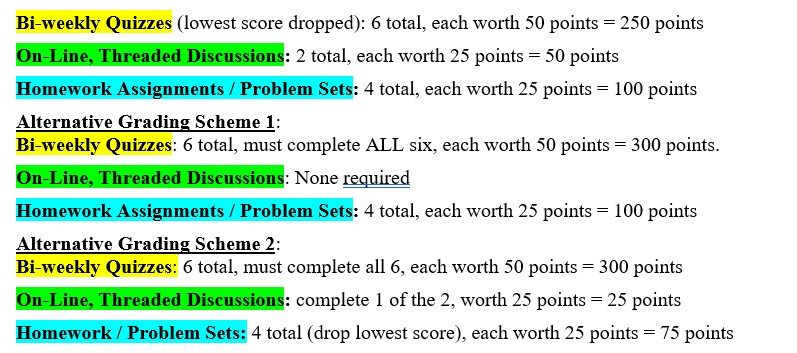
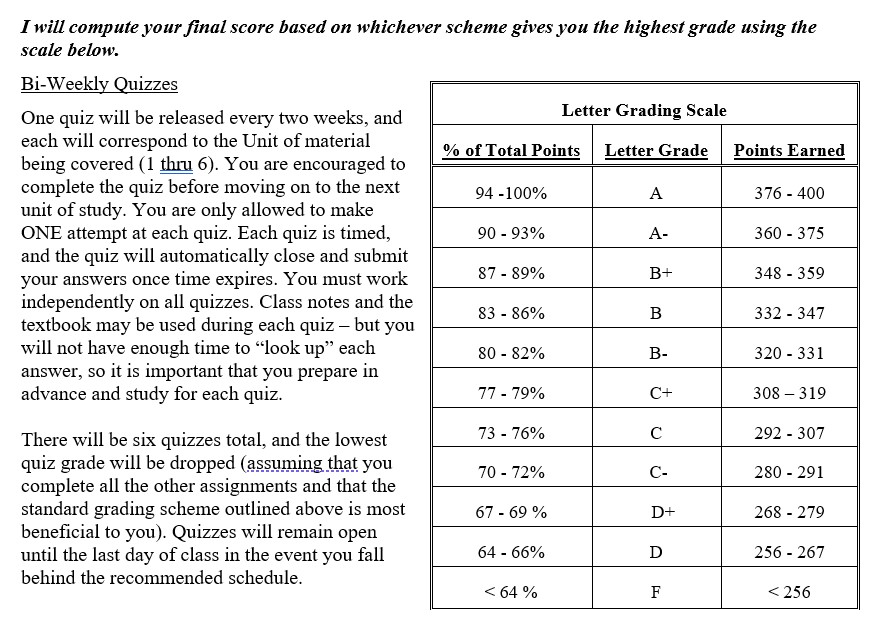
The course includes objective quizzes, homework assignments, and asynchronous threaded discussions; however, you get to decide (to a certain extent) how much each of these components is weighted in your final grade, which is based on 400 possible points.
The STANDARD Grading Scheme is as follows:
This class is part of the Sustainable Food and Farming Online Certificate Program. To register for upcoming classes, see UMass Online. Most classes cost $550/credit. If you would like to register for the Certificate program, you may apply here.
 Stockbridge Online