
STOCKSCH 268, 3 credits
ENROLL HERE
Instructor: Nicole Burton ngburton@umass.edu (413) 429-6544
Class Description:
This course is a farmer’s perspective on the sustainable management of cows, sheep and goats on a small farm. It provides students with an understanding of how to think through the planning and management of cows, sheep and goats for production. All aspects from purchasing and nutrition to marketing and finances will be addressed. This course also brings awareness to our meat industry and supports becoming an educated consumer and producer. Students will get the opportunity to focus on the animal(s) of their interest through assignments, but will be educated on cows, sheep and goats through the material presented. Students will walk away with a rudimentary plan on how to incorporate ruminants into their small farm plan.
Learning Objectives/ Course Goals:
Students will gain the knowledge related to the planning and management of a diversified livestock farm for meat production. Specifically, students will adopt the following practices
- Identify and utilize sustainable management practices for livestock
- Develop critical thinking skills on designing and implementing systems on a small farm
- Understand the rules and regulations of running a livestock farm business
- Comprehension of the complete life cycle management of ruminants for meat production
Assignments:
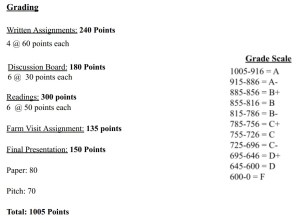
All written assignments will be focusing on the animal(s) of your choice (cow, sheep or goat) and all material is to be submitted on Canvas. Any assignment not submitted by the due date will be 2 points deducted for each day thereafter.
Discussions:
Most weeks we will have a discussion forum on a specific topic. This will be our opportunity to learn from each other and hopefully answer some questions that have come up during the week’s material. To receive full points you will be required to respond to another classmate’s post.
Readings Reflections:
Each week you will have an article or document to read and you will be responsible to write up a quick reflection. This reflection can be your personal reaction, your like or dislike of the article or the important information that you have taken from the material presented. There are also times that I may present a question to be answered. A paragraph or more will suffice.
Farm Visit Assignment:
This is your opportunity to get out into your community and explore farms of your interest. After your farm visit you will be responsible to recap the highlights on the systems used at that particular farm. This farm must include a cow, sheep or goat. These highlights will be in a blog format as if you are sharing with the public an overview of the farm. This assignment must include pictures and specific information so please review the assignment that is posted.
Final Project:
Since the majority of the assignments are focused on building a farm plan you will be responsible for a paper that will review the choices and direction you have chosen for your ideal farm and you will need to make a creative way to pitch this farm to your class. Details on this assignment will be posted on Canvas and due at the end of the semester.
Outline of Topics:
Developing Infrastructure and Understanding the Fixed Costs of Starting a Farm-
Students will acquire knowledge of the differences, advantages, and the disadvantages in breed selection, housing and fencing. Students acquire an understanding of where and how to navigate the purchasing of livestock and how to determine if they are making a good selection. Participants learn multiple options for housing and fencing that reflects a sustainable approach as well as how the expenses differ. Students will also be able to determine the best needs for their system of choice. All aspects of infrastructure covered at this time will include financial awareness.
Gaining Perspectives on Sustainable Options of Keeping Livestock Healthy-
Students will learn about the nutritional requirements of cows, sheep and goats. Students learn about the natural behavior of each animal and how it reflects their environment and the promotion of health. Students will gain an understanding of diets options that can be safely provided to cows, sheep and goats.
Understanding Breeding, Gestation Cycles & Birthing-
Students will learn about the reproduction cycles of ruminants. They will learn different approaches to breeding, necessities for birthing and raising young ruminants, as well as understanding possible challenges that arise during these cycles.
Illness and Disease and Common Problems-
Students learn how to navigate resources to support them during their animal’s time of illness. Students will develop a plan as to what steps to take when they perceive something to be wrong with an animal. Students learn the importance of their relationship with their vet and will gain confidence in being able to explain clearly their concerns. Students gain a basic understanding as to the common problems on the farm and how best to deal with the situation.
Learning Rules and Regulations-
Students will learn about their options with farm certifications, town and national regulations as well as the importance and different ways to navigate record keeping. This topic will be addressed throughout the semester.
Products & Processing-
Students will learn product options for each animal. Students gain an understanding as to how to price each product and what regulations are attached to processing that product.
Marketing –
Each student will learn about different marketing options and the challenges and benefits that are associated with them. Students will explore different media sources to acquire new customers and learn the importance of labeling, the deception of claims, and overall, how to determine the best marketing solution for their demographic location.
Structuring Finances-
Students will learn options on financial records. Students will learn about locating funding to support their farm. Students also learn about structuring their finances to include taxes, insurance and other expenses that are not always apparent with farming.
Text Books
Required
The Art and Science of Grazing: How Grass Farmers Can Create Sustainable Systems for Healthy Animals and Farm Ecosystems, by Sarah Flack, $33.95
Recommended
Storey’s Guide to Raising Beef Cattle, 3rd Edition: Health, Handling & Breeding, by Heather Smith Thomas, Storey Publishing 2009, Cost $15.25
Grass-Fed Cattle: How to produce and Market Natural Beef, by Julius Ruechel Storey Publishing, 2006, Cost $24.95
Storey’s Guide to Raising Sheep, 4th Edition: Breeding, Care, Facilities, by Carol Ekarius & Paula Simmons, Storey Publishing 2009, Cost $17.20
Storey’s Guide to Raising Meat Goats, 2nd Edition: Managing, Breeding, Marketing, by Maggie Sayer, Storey Publishing 2010, Cost $16.50
Semester Schedule
Week 1
Infrastructure: Breeds, Purchasing, Housing Fencing
Week 2
Rotational Grazing and Silvopasture Management
Week 3
Health: Rumination & Nutrition Illness, disease and parasites
Week 4
Breeding, gestation, birthing, raising young ruminants
Week 5
Slaughter, products, certifications
Week 6
Marketing and business
==============================================
Accommodation Statement
The University of Massachusetts Amherst is committed to providing an equal educational opportunity for all students. If you have a documented physical, psychological, or learning disability on file with Disability Services (DS), you may be eligible for reasonable academic accommodations to help you succeed in this course. If you have a documented disability that requires an
accommodation, please notify me within the first two weeks of the semester so that we may make appropriate arrangements. For further information, please visit Disability Services (https://www.umass.edu/disability/)
Academic Honesty Statement
Since the integrity of the academic enterprise of any institution of higher education requires honesty in scholarship and research, academic honesty is required of all students at the University of Massachusetts Amherst. Academic dishonesty is prohibited in all programs of the University. Academic dishonesty includes but is not limited to: cheating, fabrication, plagiarism, and facilitating dishonesty. Appropriate sanctions may be imposed on any student who has committed an act of academic dishonesty.
Instructors should take reasonable steps to address academic misconduct. Any person who has reason to believe that a student
has committed academic dishonesty should bring such information to the attention of the appropriate course instructor as soon as possible. Instances of academic dishonesty not related to a specific course should be brought to the attention of the appropriate department Head or Chair. Since students are expected to be familiar with this policy and the commonly accepted standards of
academic integrity, ignorance of such standards is not normally sufficient evidence of lack of intent (http://www.umass.edu/dean_students/codeofconduct/acadhonesty/).
Title IX Statement
In accordance with Title IX of the Education Amendments of 1972 that prohibits gender-based discrimination in educational settings that receive federal funds, the University of Massachusetts Amherst is committed to providing a safe learning environment for all students, free from all forms of discrimination, including sexual assault, sexual harassment, domestic violence, dating violence, stalking, and retaliation. This includes interactions in person or online through digital platforms and social media. Title IX also protects against discrimination on the basis of pregnancy, childbirth, false pregnancy, miscarriage, abortion, or related conditions, including recovery. There are resources here on campus to support you. A summary of the
available Title IX resources (confidential and non-confidential) can be found at the following link:
https://www.umass.edu/titleix/resources. You do not need to make a formal report to access them. If you need immediate support, you are not alone. Free and confidential support is available 24 hours a day / 7 days a week / 365 days a year at the SASA Hotline 413-545-0800.
 Stockbridge Online