
STOCKSCH 290P


Instructor: Nicole Burton, ngburton@umass.edu , (413) 429-6544
Nicole Burton, MS, has been a faculty member of the Stockbridge School of Agriculture at University of Massachusetts Amherst for the past 8 years. Her professional career started in the Agricultural field as a diversified livestock farmer and after 20 years shifted to an educator and applied researcher in the sustainable farming field at UMass. During her time at UMass, she has developed an integrative program with poultry, sheep and pigs being implemented into agricultural production systems in collaboration with the UMass Student Farm, UMass Carbon Farming Initiative and the Vet and Animal Science Program. Her most recent project is teaching and directing students to build a meat CSA for the UMass community. Along with educating the next generation of small farmers she continues to run a small family farm.
Preferred communication: Email, ngburton@umass.edu with an expected response within 24hours.
Office Hours: By appointment
Zoom Link: https://umass-amherst.zoom.us/j/9624352139
Course Description
This course provides students with a farmer’s perspective on the management, production and marketing of poultry on a homestead or a small farm. This course will address the advantages of having all different types of poultry, such as Chickens, Turkeys, Waterfowl, etc. This course will review the basic care and health management of poultry, their relationship with the land and other animals, their necessary infrastructure, and important marketing and financing avenues. Finally, this course will explore different alternative farming systems that utilize animals to enhance overall production. At the end of this course, students will be able to utilize poultry as an integral part of their farm plan.
Course Required Materials
The Small-Scale Poultry Flock: An all-natural approach to raising chickens and other fowl for home and market growers, by Harvey Ussery, Chelsea Green Publishing 2011, Cost $39.95
Pastured Poultry Profits: Net $25,000 in 6 months on 20 Acres, by Joel Salatin. (2010). Polyface Inc. 1996, Cost $32.00
Student Learning Outcomes
Students will gain the knowledge related to the planning and management of poultry on a farm. Specifically, students will be able to:
- Identify and use sustainable management practices for poultry
- Apply the complete life cycle management of poultry to meet meat and egg production goals
- Describe basic anatomy and physiology
- Apply basic nutritional demands to prepare appropriate feed for optimal development and use of animals
- Describe the rules and regulations of running a farm business
- Use critical thinking skills to design and implement systems on a small farm
Grading
|
Assessment Percentage |
|
|
Reading Check-Ins (15.4 points/ week) |
20 |
|
Online Discussions (15.4 points/ week) |
20 |
|
Assignments (4 at 50 points each)
Quizzes (3 at 25 points each) |
20
10 |
|
Farm Visit Paper (150 points) |
15 |
|
Special Topic Outline (25 Points) |
5 |
|
Special Topic Presentation (150 points) |
15 |
|
≥ 93.00 = A |
77.00 ≦ 79.99 = C+ |
64.00 ≦ 66.99 = D |
|
90.00 ≦ 92.99 = A- |
74.00 ≦ 76.99 = C |
<63.99 = F |
|
87.00 ≦ 89.99 = B+ |
70.00 ≦ 73.99 = C- |
|
|
84.00 ≦ 86.99 = B |
67.00 ≦ 69.99 = D+ |
Course Requirements
Weekly reading check-ins
You will be responsible for answering 2 to 3 questions pertaining to the reading each week. Expectations and a rubric for completeness is provided on Canvas.
Discussions
Participation in weekly online forum discussions. This will be our opportunity to learn from one another and to share any insight or resources about topics that we are covering. Expectations and a rubric for participation is provided on Canvas.
Farm Visit
This assignment requires searching online or in person for a farm that is similar to your production of interest. The farm you choose to ‘visit’ must raise at least one of the animals we focus on in class. Visit the farm, reflect on class material and set up a series of questions that you can ask the farm manager. I highly recommend you try to work with the farm you select if possible, but this is not a requirement. After the farm visit, you will submit a paper with the description of the farm and insights and new knowledge you gained. Assignment details and rubric is provided on Canvas.
Special Topic Project
You will choose a topic of interest in the field of poultry. Topic descriptions are due at the end of the first quarter of the semester and an outline will be submitted at mid-term. At the end of the semester you will teach the class, via a presentation, about your findings from your research on the topic. You will also submit a personal reflection on the major take away points learned from your research. Assignment details and rubric is provided on Canvas.
Make up Policy
If you are unable to do the work expected for the week due to illness or family concerns please reach out to the instructor to make arrangements and schedule an appropriate time period to submit your work.
Outline of Topics
Developing Infrastructure and Understanding the Fixed Costs of Starting a Farm- Students will learn the differences, advantages, and the disadvantages in breed selection, housing and fencing. We will review where and how to navigate the purchasing of poultry and how to determine if you made an appropriate selection. You will learn multiple options for housing that reflect a sustainable approach as well as how the expenses differ. You will also determine the best needs for your farming system of choice. All aspects of infrastructure covered at this time will include financial awareness.
Gaining Perspectives on Sustainable Options of Keeping Livestock Healthy- Students will learn about the nutritional requirements of all poultry. Students will learn about the natural behavior of each animal through observation and lectures, and be able to determine how best to provide an environment that promotes health. Students will gain an understanding of alternative diets that can be safely provided to poultry and that allow them to appropriately integrate them into their farming system.
Understanding Breeding & Hatching Systems- Students will learn about the reproduction cycles of poultry. They will learn different approaches to breeding, necessities for brooding, and all options for hatching eggs, as well as understanding possible challenges that arise during this process.
Illness and Disease and Common Problems- Students learn how to navigate resources to support them during their animal’s time of illness. Students will develop a plan as to what steps to take when they perceive something to be wrong with an animal. Students learn the importance of their relationship with their vet and will gain confidence in being able to explain clearly their concerns. Students gain a basic understanding as to the common problems on the farm and how they are transmitted..
Learning Rules and Regulations- Students will learn about their options with farm certifications, town and national regulations as well as the importance and different ways to navigate record keeping. This topic will be addressed throughout the semester.
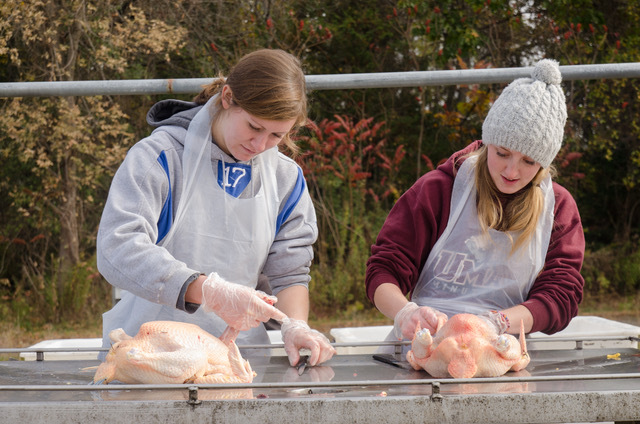
Products & Processing- Students will learn product options for each animal. Students gain an understanding as to how to price each product and what rules and regulations are attached to processing that product. Students will learn about legally processing birds with USDA exemptions. Students will learn how to price and evaluate their products.
Marketing – Each student will learn about different marketing options and what requirements and challenges that are associated with them. Students will explore different media sources to acquire new customers and learn the importance of labeling, the deception of claims, and overall how to determine the best marketing solution for their demographic location.
Structuring Finances- Students will learn options on financial records. Students will learn how to find funding to support their farm. Students also learn about structuring their finances to include taxes, insurance and other expenses that are not always apparent with farming. Students learn how to recognize fixed versus variable costs and how to create a practical enterprise budget.
Week 1: Introduction to the course and each other
Week 2: Purchasing and Selecting Poultry Species and Breeds
Week 3: Housing
Week 4: Fencing and Predator Control
Week 5: Breeding Systems
Week 6: Nutrition
Week 7: Incubation and Brooding Systems
Week 8: Illness and Disease
Week 9: Turkeys
Week 10: Waterfowl
Week 11; Integrating poultry into production systems
Week 12: Marketing
Week 13: Finance
Week 14: Final presentations
Accommodation Statement
The University of Massachusetts Amherst is committed to providing an equal educational opportunity for all students. If you have a documented physical, psychological, or learning disability on file with Disability Services (DS), you may be eligible for reasonable academic accommodations to help you succeed in this course. If you have a documented disability that requires an accommodation, please notify me within the first two weeks of the semester so that we may make appropriate arrangements. For further information, please visit Disability Services (https://www.umass.edu/disability/)
Academic Honesty Statement
Since the integrity of the academic enterprise of any institution of higher education requires honesty in scholarship and research, academic honesty is required of all students at the University of Massachusetts Amherst. Academic dishonesty is prohibited in all programs of the University. Academic dishonesty includes but is not limited to: cheating, fabrication, plagiarism, and facilitating dishonesty. Appropriate sanctions may be imposed on any student who has committed an act of academic dishonesty. Instructors should take reasonable steps to address academic misconduct. Any person who has reason to believe that a student has committed academic dishonesty should bring such information to the attention of the appropriate course instructor as soon as possible. Instances of academic dishonesty not related to a specific course should be brought to the attention of the appropriate department Head or Chair. Since students are expected to be familiar with this policy and the commonly accepted standards of academic integrity, ignorance of such standards is not normally sufficient evidence of lack of intent (http://www.umass.edu/dean_students/codeofconduct/acadhonesty/).
Title IX Statement
Title IX Statement – Faculty must include ONE of the below Title IX statements. All faculty are non-Responsible Employees/non-Mandatory Reporters UNLESS told by UMass administration that they are a Responsible Employee/Mandatory Reporter. Most faculty will fall into the non-Responsible Employee/non-mandatory reporter category. Pursuant to the current MSP contract, “Vice Chancellors, Vice Provosts, Deans, Department Heads, and Directors (including Directors of Centers and Institutes and Graduate and Undergraduate program directors) as well as employees specifically tasked with responding to incidents of sexual harassment and violence are “responsible employees” for Title IX purposes and must report incidents of sexual misconduct to the Title IX Coordinator. All such employees that are members of the MSP will be notified of their obligations.”
#1: Title IX Statement (non-Responsible Employee/non-mandatory reporter statement—all faculty should use this statement unless told otherwise by UMass admin)
In accordance with Title IX of the Education Amendments of 1972 that prohibits gender-based discrimination in educational settings that receive federal funds, the University of Massachusetts Amherst is committed to providing a safe learning environment for all students, free from all forms of discrimination, including sexual assault, sexual harassment, domestic violence, dating violence, stalking, and retaliation. This includes interactions in person or online through digital platforms and social media. Title IX also protects against discrimination on the basis of pregnancy, childbirth, false pregnancy, miscarriage, abortion, or related conditions, including recovery. There are resources here on campus to support you. A summary of the available Title IX resources (confidential and non-confidential) can be found at the following link: https://www.umass.edu/titleix/resources. You do not need to make a formal report to access them. If you need immediate support, you are not alone. Free and confidential support is available 24 hours a day / 7 days a week / 365 days a year at the SASA Hotline 413-545-0800.
#2: Title IX Statement (use this statement ONLY if you have been told by UMass administration that you are a Responsible Employee/Mandatory Reporter)
In accordance with Title IX of the Education Amendments of 1972 that prohibits gender-based discrimination in educational settings that receive federal funds, the University of Massachusetts Amherst is committed to providing a safe learning environment for all students, free from all forms of discrimination, including sexual assault, sexual harassment, domestic violence, dating violence, stalking, and retaliation. This includes interactions in person or online through digital platforms and social media. Title IX also protects against discrimination on the basis of pregnancy, childbirth, false pregnancy, miscarriage, abortion, or related conditions, including recovery. There are resources here on campus to support you. A summary of the available Title IX resources (confidential and non-confidential) can be found at the following link: https://www.umass.edu/titleix/resources. You do not need to make a formal report to access them. If you need immediate support, you are not alone. Free and confidential support is available 24 hours a day / 7 days a week / 365 days a year at the SASA Hotline 413-545-0800.
For purposes of Title IX reporting, I am a considered a “responsible employee” at UMass (https://www.umass.edu/titleix/about). That means that if you tell me about a situation involving sexual assault, sexual harassment, domestic violence, dating violence, stalking, and retaliation, I must share that information with the Title IX Coordinator. Making a report to the Title IX Coordinator is my legal obligation, meets the University’s goal of providing members of our community with supportive resources they might need, and enables the University to obtain a more accurate picture of the extent of sexual violence in our community. It will be completely up to you to determine if and how you want to work with the Title IX Coordinator’s office. You will not be in trouble for reporting to me that you have experienced any of these situations, and the law prohibits retaliation against anyone who participates in a Title IX process.
———————————————–
This class fulfills requirements for all three of the online programs offered by the University of Massachusetts Stockbridge School of Agriculture in Sustainable Food and Farming:
This online class costs $550/credit.
 Stockbridge Online