
STOCKSCH 108 (4 Credits)
How to Enroll in an Online Class

Instructor: Dr. Corcoran (Dr. C)
Instructors Bio:
Email: sglazecorcor@umass.edu
Course Description: This course provides a comprehensive overview of plant biology, including anatomy, morphology, physiology, development, genetics, reproduction, evolution, and classification. Students will make connections between fundamental science and practical applications in agronomy, horticulture, forestry, turf, landscape management, and natural resource management. Throughout the course, students will develop critical scientific reasoning skills and gain a strong foundation in plant science, preparing them to make informed decisions and pursue more advanced studies in related fields.
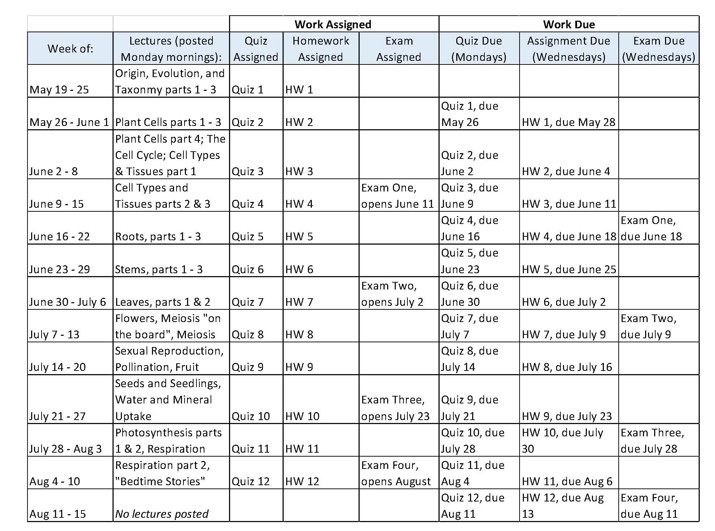
Course Structure: Each week I will post three recorded lectures on Monday along with a quiz and homework assignment. Lectures can be watched on your own schedule. Quizzes will be due the following Monday. Homework assignments will be due the following Wednesday. On the due date, the submission deadline is always 11:59 PM ET.
Each lecture is approximately 50 minutes long. A PDF of the slides will be provided. On weeks that exams are also assigned, I will post only two lectures.
Exams will be posted on Wednesdays. Exams will be due the following Wednesday, also by 11:59 PM ET. Study guides for the exams will be posted one week before the exam is posted.
Communication Policy: I will read and reply to course-related emails in the early morning, evening, and on weekends. I nearly always reply on the same day to any emails received by 7 PM. If 24 hours have passed and you have not received a reply, please email me again.
If there is a time sensitive issue between 9:00 AM and 5:00 PM (for example, a quiz is supposed to be open but it is not working properly) please start the subject line of your email with the words “TIME SENSITIVE”, all caps.
Office Hours: When the course begins, I will share a survey to identify the best time(s) to hold weekly, live office hours over zoom.
Textbooks:
Required: Pending. This course will include readings and assignments from an applied botany text. Candidate texts are currently in review. The selected text is anticipated to cost $25-50 new.
Not required: Botany: An Introduction to Plant Biology, 7th Edition by James D. Mauseth.
The slides for this course will serve as the textbook. Slides include all text and diagrams necessary to complete homework assignments, quizzes, and exams. This book was used during course development, and is recommended to students who prefer to have a textbook. However, there will be no required reading from this text.
Learning Goals (Big picture things that I hope you take away from this class)
Perception goals:
- Students enjoy plants and appreciate the wonder of their existence.
- Students feel confident in their ability to engage in discussions about plants.
- Students value the science that underlies plant management.
Tangible goals:
- Students receive a thorough introduction to plant science to support their future coursework and careers.
- Students gain a working knowledge of plant structure and function.
- Students perceive and internalize the connections between plant science and applied plant management.
- Students develop scientific literacy and critical reasoning skills.
Learning Objectives (Specific things that you should be able to do as a result of taking this class)
- Identify primary plant structures, both macro and micro.
- Differentiate between monocots and dicots on sight, regardless of developmental stage.
- Utilize subject matter vocabulary.
- Recognize plant cells and plant tissues under a microscope.
- Explain the purposes and processes of photosynthesis, respiration, and water & nutrient uptake.
- Use working knowledge of botany to appraise, critique, and correct misinformation in non-scientific sources (such as public blogs).
- Apply botanical knowledge to interpret plant behavior in both cultivated and wild conditions.
- Evaluate plant-management decisions guided by scientific understanding.

Grading: Note that this course uses weighted grading.
- Quizzes, 33.3% of the grade (weekly)
- 12 total, 20 points each, two lowest scores dropped = 200 points
- Homework Assignments, 33.3% of the grade (weekly)
- 12 total, 20 points each, two lowest scores dropped = 200 points
- Exams, 33.3% of the grade
- 4 total, 50 points each = 200 points
Grading Scale (rounded to nearest whole number. 0.5-0.9 rounds up. 0.1-0.4 rounds down):

Additional Detail:
Quizzes: Each quiz has 20 questions that cover material from the week’s lectures. Students will have two attempts to take quizzes; the final grade for the quiz is the average of both attempts. The second attempt will have some of the same questions as the first attempt, and some new questions. You have three hours to complete two attempts. Once the first attempt is made, you must complete the second attempt within the three-hour time block. For example, if you start the quiz at noon, you must finish by 3pm the same day.
Homework Assignments: Homework assignments will be a mixture of activities. Examples include:
- Identify the misinformation on an assigned webpage. Explain why it is wrong. Rewrite the information to make it clear and correct.
- Diagnose the issue of failing plants in a provided case study, using signs of plant stress, site characteristics, and microscopic images of cells and tissues. Write an accessible, scientifically supported explanation to the owner of the site explaining the issue, how you reached your diagnosis, and provide them with management options.
- Take yourself on a field trip to your own garden, a public botanical garden, a forest, a nursery, the plant section of a hardware store, a job site, etc. and find and identify plant structures (from an assigned list). Take pictures of the plant structures and create a labeled photo journal.
- Write a response to a real question that Dr. C receives from a member of the general public (with their consent to share the question). The best student answer(s) will actually be used to answer the question.
- Run an at home germination experiment, modifying light, temperature, and/or moisture. Analyze and interpret the results gathered by the class as a whole.
Exams: You will have 50 minutes and one attempt to take exams. Exams will include multiple choice and true/false questions, along with short answer and extended response questions. The multiple choice and true/false questions will utilize vocabulary that you learn in class, but they will require critical thinking to answer correctly. A study guide will be provided for each exam a week prior to when the exam will open. I will also host virtual review sessions (schedule by class vote). Theoretically, you can look up answers on the internet and use your notes while taking exams. However, given the length and format of the exams, it is not a good idea to take the exam without watching the lectures, taking notes, and using the study guide to prepare.
FAQs & Course Policies
Q: How is the workload determined?
A: This course has been adapted from when I taught STOCHSCH 108 in person on a MWF schedule. In addition to three lectures per week, the in-person version of this course has a weekly, 2 hour laboratory. The lab is the reason that the in-person course is 4 credits instead of 3 credits. This online course does not have a weekly lab, but it is still 4 credits. Instead of a lab, there are weekly homework assignments that should take up to, but not more than, 2 hours.
Q: What should I do if I have a question on the lecture content, an assignment, or just a general curiosity question?
A; Unless it is a personal/private question, please post it on the course discussion board where I can answer it for everyone to see. Others may have the same question.
Q: I am worried I might lose track of what is due or get behind watching lectures. What should I do?
Check your email. Every week I will send out a reminder of what is going on, what is due, questions that came up in the discussion board, etc. to help you stay on track. In addition, each week, I use course website tools to see when every person last logged in, if they have been completing their work, and how their grades are looking. If I notice you are getting behind, I will email you to check in. If you get a “check-in” email, this does not mean you are in trouble! These check-in emails are meant to help you know that if you disappear, I do notice, and I will try to help you.
Q: Will we have to use the discussion board for assignments?
A: I am teaching this course online for the first time in 2025 and I am still developing some of the assignments. Based on my experience teaching online in the past, I know that discussion boards can be great, or they can be a waste of your time. You will have to use the discussion board for assignments only if I come up with a good reason / good way to structure it. Stay tuned.
Q: I missed a quiz or assignment, can I have an extension?
A: No. I drop the two lowest quiz grades AND the two lowest assignment grades. If you miss a due date the grade will default to a zero. These dropped grades provide you with flexibility.
Q: I did poorly on a quiz or assignment, can I resubmit it?
A: No. I drop the two lowest quiz grades AND the two lowest assignment grades. If you do poorly, these dropped grades give you a second chance to do better next time.
Q: I did poorly on an exam, can I retake it?
A: No.
Q: I am going to be traveling and something is due, what can I do?
A: If it is a quiz or assignment that you cannot complete, you will receive a zero and these can be dropped as the lowest grades.
If it is an exam, please let me know early in the semester so we can make plans for an alternative due date.
Q: I don’t want to use my dropped grades for missed assignments due to being sick / traveling, etc. I only want to use my dropped grades for poor scores.
A: No. The two dropped quiz grades AND the two dropped assignment grades are the two lowest grades in each category, regardless of the reason for the low grade.
Q: I did great on quizzes but poorly on assignments. Can you drop my four lowest assignment grades instead?
No.
Q: I had a technical issue while taking the quiz / exam, what can I do?
A: Send me an email. If you repeatedly have issues with internet connections or your computer, plan to make arrangements to access a reliable computer and internet connection.
Q: Can I use chatGPT/other AI tools?
A: AI may not be used to write your assignments or answer exam questions. I will use an AI writing detector. Using AI to write your assignments and exam questions will be treated equal to plagiarism. AI tools can also be completely wrong and are a good way to come up with wrong answers.
Q: What are the consequences for plagiarism / using an AI writing tool on an assignment or exam?
In addition to an AI detector, I will use a plagiarism detector. I will follow the University policies for academic dishonesty to the full extent. Policies can be found at the following link: https://www.umass.edu/senate/book/academic-regulations-academic-honesty-policy#resources
Accommodations: The University of Massachusetts Amherst is committed to providing an equal educational opportunity for all students. If you have a documented physical, psychological, or learning disability on file with Disability Services (DS), you may be eligible for reasonable academic accommodations to help you succeed in this course. If you have a documented disability that requires an accommodation, please notify me within the first two weeks of the semester so that we may make appropriate arrangements. For further information, please visit Disability Services (https://www.umass.edu/disability/)
Academic Honesty: Since the integrity of the academic enterprise of any institution of higher education requires honesty in scholarship and research, academic honesty is required of all students at the University of Massachusetts Amherst. Academic dishonesty is prohibited in all programs of the University. Academic dishonesty includes but is not limited to: cheating, fabrication, plagiarism, and facilitating dishonesty. Appropriate sanctions may be imposed on any student who has committed an act of academic dishonesty. Instructors should take reasonable steps to address academic misconduct. Any person who has reason to believe that a student has committed academic dishonesty should bring such information to the attention of the appropriate course instructor as soon as possible. Instances of academic dishonesty not related to a specific course should be brought to the attention of the appropriate department Head or Chair. Since students are expected to be familiar with this policy and the commonly accepted standards of academic integrity, ignorance of such standards is not normally sufficient evidence of lack of intent (http://www.umass.edu/dean_students/codeofconduct/acadhonesty/).
————————————————————————————
This class fulfills requirements many of the online programs offered by the University of Massachusetts Stockbridge School of Agriculture in Sustainable Food and Farming:
- Online 15-Credit Certificate in SFF
- Online 15-Credit Certificate in Horticulture
- Online Associate of Science Degree in SFF
- Online Associate of Science Degree in Horticulture
- Online Bachelor of Science Degree in SFF
 Stockbridge Online