
STOCKSCH 290A – Intro to Agroforestry – 3 credits
Online Instructor: Jono Neiger
Preferred Contact, email: jono@rdgland.com
Office Hours by Appointment
Course Overview and Objectives:
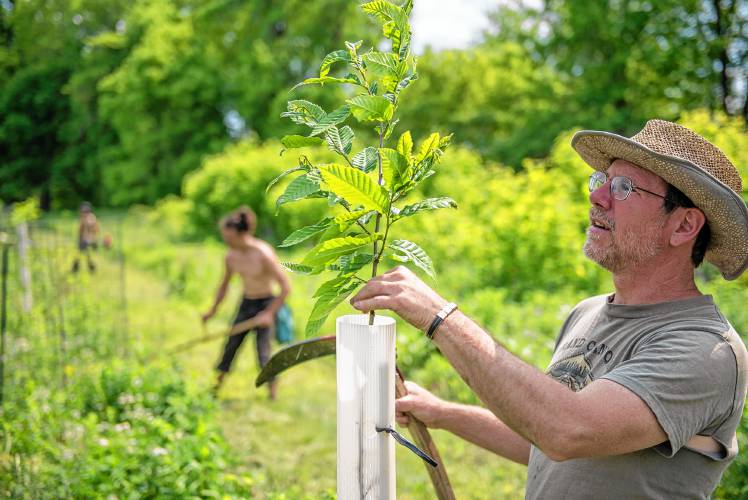
This course serves as a broad overview of agroforestry, and a survey of agroforestry practices, systems, and farm integration. Agroforestry is rooted in indigenous land management and historic farming, where trees and perennial crops are integrated in complex farm systems in numerous pattens. The NRCS defines five agroforestry practices: windbreaks, riparian buffers, silvopasture, alley cropping, and forest farming, but there are myriad gradations and variations.
Though practiced globally, agroforestry is gaining traction for farms in the northeast US as it allows diversification and integration of tree crops into various landscapes that may not be as suitable to other crop systems. Adding trees through agroforestry is also an opportunity to regenerate and utilize degraded and denuded land and add carbon capture and other ecosystem function at the same time.
The focus for the course is agroforestry as a commercial farm and land-use practice, covering the five primary agroforestry systems and the their patterns of implementation. We cover the ecological benefits, design and planning of agroforestry systems, and the current network of practitioners, organizations and agencies that are supporting and implementing agroforestry. The course ends with an exploration of opportunities to get involved or integrate agroforestry in farm and land management.
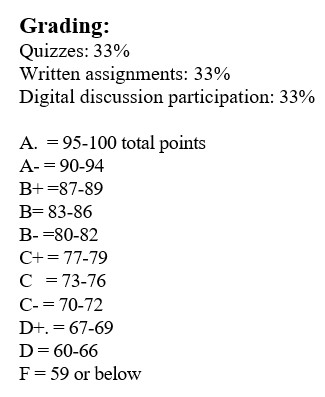
Evaluation
Comprehension quizzes 33%: Weekly quizzes will evaluate students’ understanding of the subject. Each quiz will be posted on Canvas platform and will cover the course material (power point slides and readings).
Online discussion 33%: Class powerpoints, readings and videos from a variety of sources will be assigned each week. Each student will post to the class website a question or opinion based on the readings, then respond to the posting of another student. Strong opinions and civility are strongly encouraged. Forum posts will be evaluated based on relevance and quality of post, as well as contribution to the learning community.
Writing assignments 33%: Weekly writing assignments will allow reflection and discussion on readings and powerpoint sessions.
Make-Up Policy: Students who don’t complete work on time due to extenuating circumstances should contact instructor in a timely fashion about making up missed work. Reasonable assistance will be given for missed work.
LEARNING OBJECTIVES:
Through completion of this course students will be able:
- Identify and understand the five basic patterns of agroforestry systems
- Understand the historic and indigenous context for perennial cropping, tree crops, and agroforestry
- Know the key factors for success in implementing agroforestry systems
- Comprehension of the ecological services and climate change adaptation opportunity of agroforestry
- Understand the process and key factors for design and planning of a new agroforestry system or integrating onto an existing farm
- Know some product and market channel opportunities for agroforestry
- Summarize the current agroforestry network and key organizations in the US and internationally
Accommodation Statement:
The University of Massachusetts Amherst is committed to providing an equal educational opportunity for all students. If you have a documented physical, psychological, or learning disability on file with Disability Services (DS), you may be eligible for reasonable academic accommodations to help you succeed in this course. If you have a documented disability that requires an accommodation, please notify me within the first two weeks of the semester so that we may make appropriate arrangements.
Academic Honesty Statement:
Since the integrity of the academic enterprise of any institution of higher education requires honesty in scholarship and research, academic honesty is required of all students at the University of Massachusetts Amherst. Academic dishonesty is prohibited in all programs of the University. Academic dishonesty includes but is not limited to: cheating, fabrication, plagiarism, and facilitating dishonesty. Appropriate sanctions may be imposed on any student who has committed an act of academic dishonesty. Instructors should take reasonable steps to address academic misconduct. Any person who has reason to believe that a student has committed academic dishonesty should bring such information to the attention of the appropriate course instructor as soon as
possible. Instances of academic dishonesty not related to a specific course should be brought to the attention of the appropriate department Head or Chair. Since students are expected to be familiar with this policy and the commonly accepted standards of academic integrity, ignorance of such standards is not normally sufficient evidence of lack of intent (http://www.umass.edu/dean_students/codeofconduct/acadhonesty/).
Title IX Statement:
In accordance with Title IX of the Education Amendments of 1972 that prohibits gender- based discrimination in educational settings that receive federal funds, the University
of Massachusetts Amherst is committed to providing a safe learning environment for all students, free from all forms of discrimination, including sexual assault, sexual harassment, domestic violence, dating violence, stalking, and retaliation. This includes interactions in person or online through digital platforms and social media. Title IX also protects against discrimination on the basis of pregnancy, childbirth, false pregnancy, miscarriage, abortion, or related conditions, including recovery. There are resources here on campus to support you. A summary of the available Title IX resources (confidential and non-confidential) can be found at the following link:
https://www.umass.edu/titleix/resources. You do not need to make a formal report to access them. If you need immediate support, you are not alone. Free and confidential
support is available 24 hours a day / 7 days a week / 365 days a year at the SASA Hotline 413-545-0800.
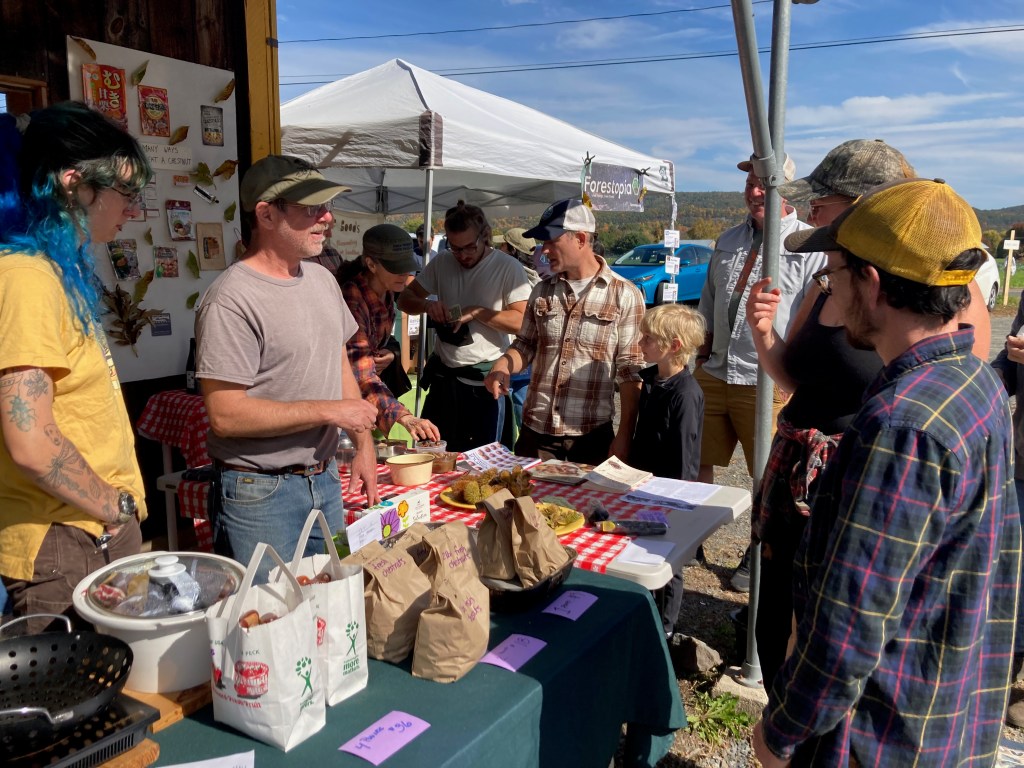
Selling fresh and roasted chestnuts at the fall harvest festival
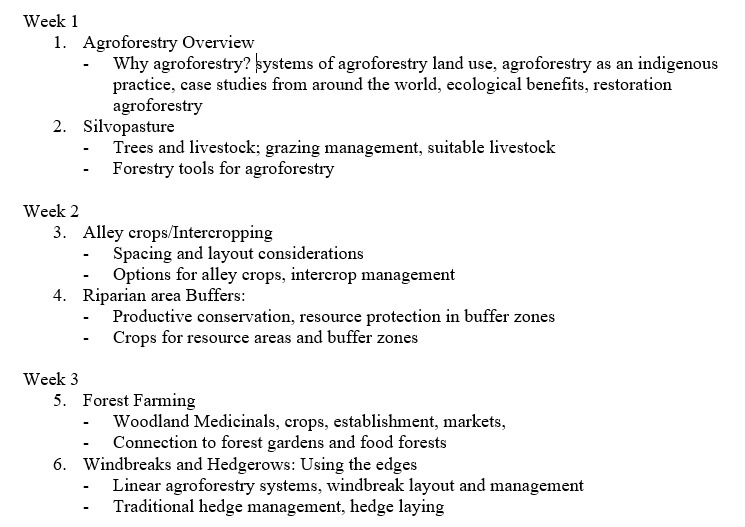
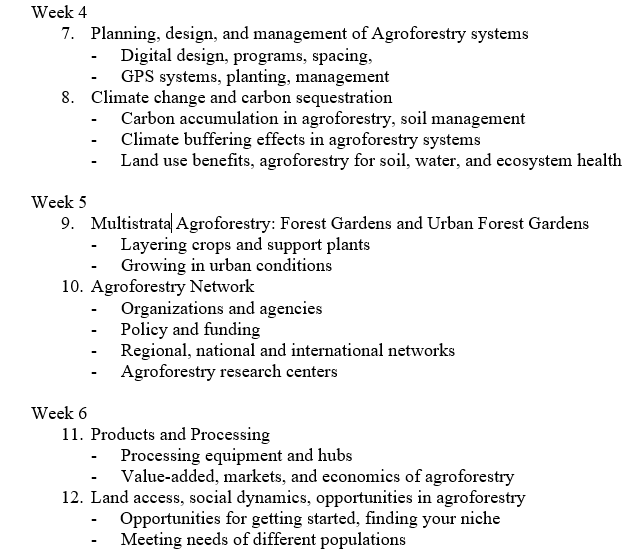
Outline of Content:
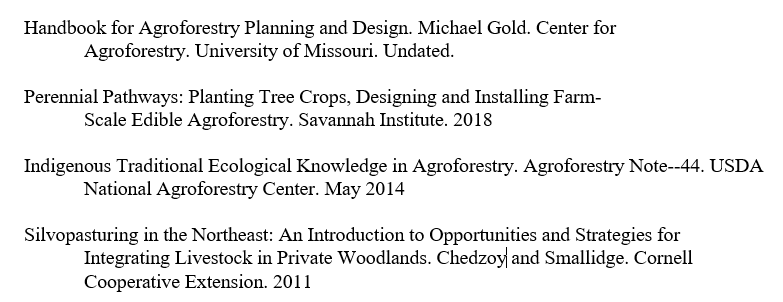
Sample of Course Required Readings:
 Stockbridge Online